Internet Mastery Accelerator 5
Action Items
Mark Leas
☐ Build out and implement creating own Amazon listings
☐ Spend the next few weeks creating unique product listings
☐ Obtain GS1-compliant UPC barcodes for new listings
☐ Raise prices on listings where sole seller (small increment)
Amazon Selling Landscape and Strategic Pivots
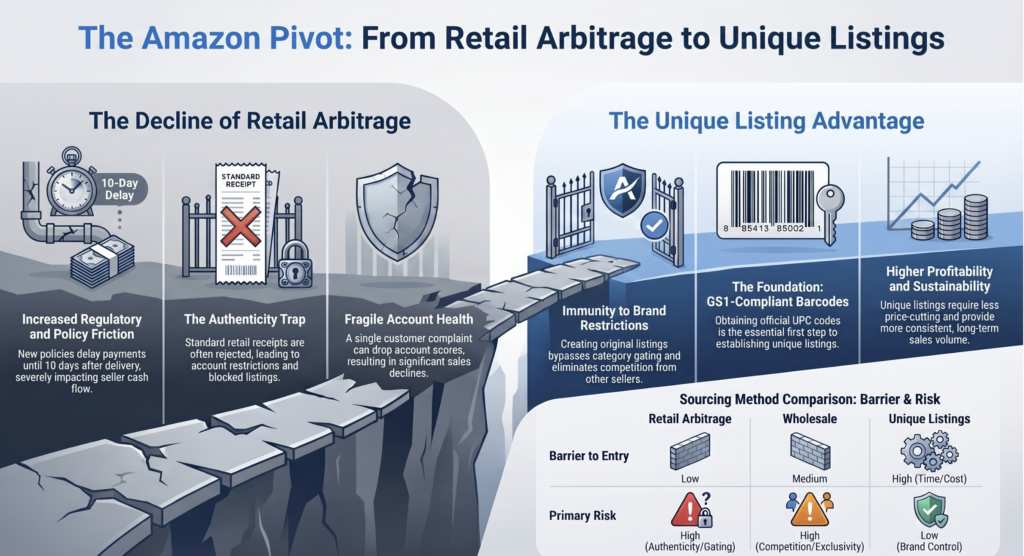
- Amazon is making selling increasingly difficult for third-party sellers.
- A seller’s account score dropped to 200 due to a single complaint, resulting in a significant sales decline over two months.
- Payment policy change: Amazon now pays sellers 10 days after item delivery, a shift from the previous policy of paying upon shipment.
- This change impacts cash flow, bill payments, and inventory purchasing.
- The rationale is to address issues with bad shipments or customer dissatisfaction.
- Increased “red tape” and challenges:
- Category gating and brand restrictions are significant issues.
- Authenticity claims are more prevalent, with receipts from standard retailers often not accepted.
- Pricing uncertainty is a growing concern.
Product Sourcing Methods and Associated Problems
- Four primary methods of product sourcing: Retail Arbitrage, Wholesale, Private Label, and Branding.
- Retail Arbitrage:
- Has the lowest barrier to entry but poses the biggest problems.
- TEMU: Products purchased from TEMU cannot be used to validate authenticity claims, leading to account blocks or restrictions.
- Wholesale:
- Faces high competition as many wholesalers sell to numerous Amazon sellers.
- Reputable wholesalers often have brand-exclusive deals or do not sell to Amazon sellers, making it difficult to compete with bulk buyers.
- Private Label and Branding:
- Require significant financial investment and time.
Creating Own Listings as a Solution
- Creating unique product listings directly addresses key Amazon selling challenges:
- Solves brand restriction issues.
- Mitigates pricing uncertainties.
- Resolves authenticity claims.
- Essential requirements for creating listings:
- Product
- Images
- Titles and descriptions
- Keywords
- Paid advertising (for driving traffic)
- Reviews (e.g., Amazon Vine program, or personal network for authentic reviews)
- Crucial first step: Obtaining a GS1 barcode (UPC code).
- Benefits of self-created listings (validated by Mark Leas):
- More profitable due to less need for price adjustments.
- More sustainable, allowing for continuous sales of the same product.
- Higher percentage of sales contribution compared to retail arbitrage products.
- While time-consuming (1-3 hours per listing), it is more efficient than spending hours on retail arbitrage to find profitable, ungated products.
Strategic Direction and Future Outlook
- Amazon’s evolving strategy:
- Amazon appears to be moving towards dealing directly with brand owners and manufacturers, aiming to eliminate middlemen.
- The belief that Amazon copies best-selling products to create its own generic versions is considered a myth; Amazon wants brands to sell on its platform.
- Amazon seeks unique, high-value products that people desire.
- Seller adaptation:
- Sellers should pivot towards creating their own unique listings or bundles.
- A recommended strategy is to identify popular products and create improved or similar versions, rather than inventing entirely new products.
- Avoid overthinking product ideas; focus on trial and error with multiple concepts.
- Advice for Mark Leas:
- Mark has created 10 unique listings out of 130-150 SKUs, with 3 of these being among his top 10 best-selling products.
- These self-created listings are more profitable.
- Mark should consider raising prices on his exclusive listings (e.g., from $13 to $14) as he is the sole seller.
- Mark’s plan to focus on building out more self-created listings is aligned with the current Amazon landscape.
- Mark’s Amazon account is currently restricted, awaiting a response from Amazon.
- The discussion will continue in subsequent sessions, with feedback from other participants.
Action Items
☐ Enroll your brand in Amazon Brand Registry
☐ Purchase GS1 barcodes for your products or bundles
☐ Use the IP Accelerator to expedite Brand Registry
☐ List sample items on Amazon to practice listings
☐ Prepare images and copy for A+ content creation
☐ Reply in chat if you are Brand Registry approved
☐ Return from lunch and reconvene at 1:00 PM
GS1 Barcodes
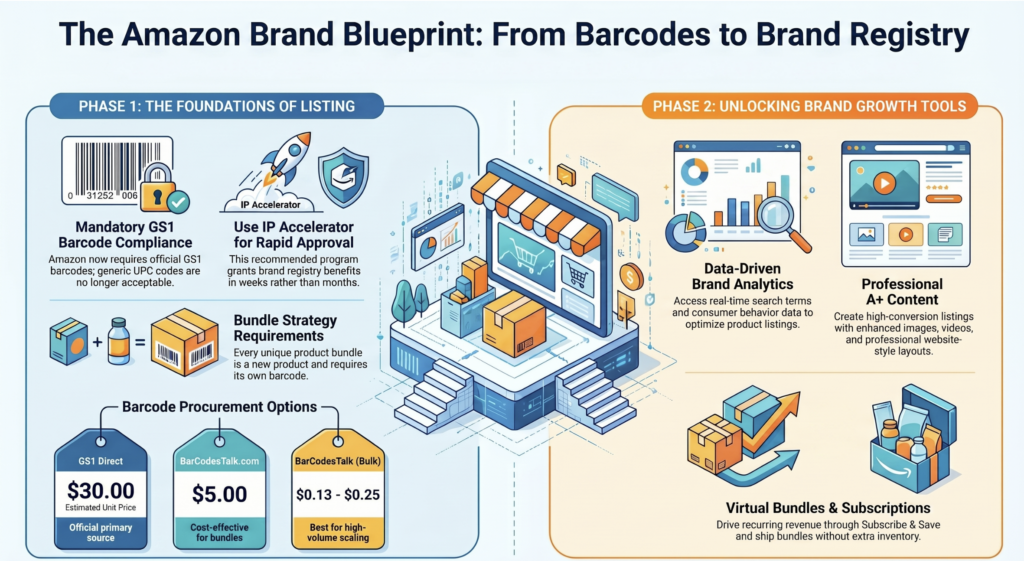
- Amazon requires GS1 barcodes for products.
- Generic UPC codes, previously acceptable, are no longer sufficient.
- Bundles are considered new products and require a new UPC code.
- Purchasing options for GS1 barcodes:
- Directly from GS1: Costs $30 for one barcode.
- BarCodesTalk.com: Offers 100% authentic GS1 barcodes for $5 each, with prices decreasing for bulk purchases (e.g., 25 cents or 13 cents each for 100s or 500s).
- BarCodesTalk.com recirculates barcodes from products no longer in use.
- Recommendation is to purchase from BarCodesTalk.com, especially for creating bundles, and to buy in bulk (100, 200, or 500 barcodes).
Amazon Brand Registry
- Enrollment Process:
- Access through sell.Amazon.com/brand-registry or by searching “Amazon Brand Registry” on Google.
- Two methods for enrollment:
- Regular method: Time-consuming.
- IP Accelerator program: Recommended for faster and guaranteed approval.
- Connects with Amazon-vetted legal teams.
- Customer Support paid $500 or $1200 for this service.
- Approval for Brand Registry is granted upon finalizing the deal with the service provider, even before the trademark is fully approved.
- Approval can take 4-6 weeks if all necessary information is provided.
- An LLC can be used for brand registration, and one LLC can cover multiple businesses.
- A step-by-step guide for Brand Registry is not provided by Customer Support, suggesting the use of AI tools like ChatGPT for guidance.
- Key Benefits and Features:
- Subscribe & Save: Allows offering recurring purchases to customers.
- A+ Content: Enables creation of professional, website-like product listings with enhanced images and videos.
- Customer Support uses a graphic designer for A+ content creation.
- Amazon’s AI tools for A+ content generation:
- Can generate images and text, and provide insights based on Amazon shopping trends when an ASIN is entered.
- Demonstration showed the AI pulled from existing images and generated text that exceeded character limits.
- Generated images (e.g., flowers) were not preferred by Customer Support.
- Amazon’s AI for A+ content is considered not user-friendly and less effective compared to other AI tools or custom design.
- Manage IP Complaints: Provides tools to address intellectual property infringements.
- Storefront: Allows building a customized brand storefront on Amazon.
- Example of a well-designed “Pure” store was shown.
- Customer Support’s own storefront requires updating.
- Brand Analytics: Offers detailed data and insights.
- Provides information on how, where, and when customers find products, including keywords and trends.
- Includes Search Catalog Performance, Consumer Behavior, and Demographics.
- Top Search Terms (within Search Analytics): Offers real-time data on keywords searched on Amazon across all categories.
- Lower numerical rankings indicate more popular keywords (e.g., “omega 3” at 460).
- Allows analysis of top brands, ASINs, conversion rates, and product titles for specific search terms.
- Keywords are crucial for optimizing listings to appear in search results.
- Enables analysis of competitors’ images, A+ content, titles, and descriptions.
- Amazon Vine: Access to the Vine program for product reviews.
- Brand Tailored Promotions.
- Virtual Bundles: Allows creating bundles of existing listings without sending additional inventory to Amazon; Amazon ships items separately.
- Transparency Codes.
- Advertising options.
AI Tools and Search Trends
- Prediction: Search functionality will transition from traditional search engines like Google to AI platforms (e.g., ChatGPT, Gemini, Claude) within the next 1-2 years.
- Bing, owned by Microsoft, currently receives more search traffic than Google and offers AI-powered search results.
- AI tools can significantly save time in research, but users should be aware that they can make mistakes.
Action Items
Customer Support
☐ Bring the printed workbook for tomorrow’s session
Unassigned
☐ Obtain UPC codes for products to list
☐ Create main product image plus nine additional images
☐ Hire a designer to create product label and images
☐ Ensure Amazon listing images are square for listing
☐ Create a ChatGPT project and upload listing sources
☐ Upload prepared images to the Amazon product listing
☐ Bring laptops to the hands‑on workshop
☐ Attend Boca Farmers Market tomorrow 9:00 AM–1:00 PM
☐ Be prepared to appear on camera during market
☐ Meet at the office around 1:30 PM after market
Accelerator 5.0 Training Overview
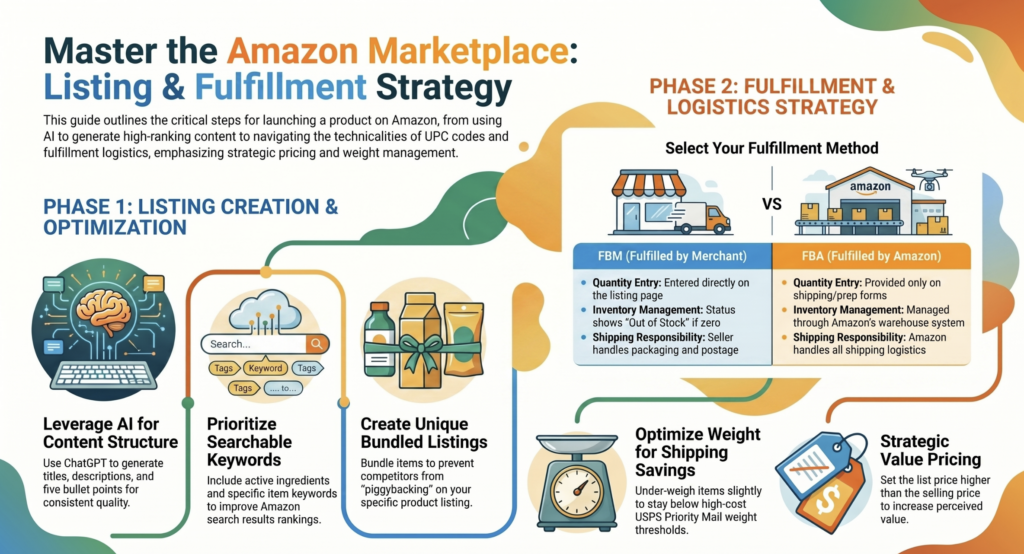
- The training focuses on listing items directly on Amazon that are not currently available on the platform.
- Melissa had requested this detailed discussion for over two years.
- The primary challenge for participants is the application of the information provided.
- Building a large e-commerce business requires Amazon as a core strategy.
Amazon Listing Creation Essentials
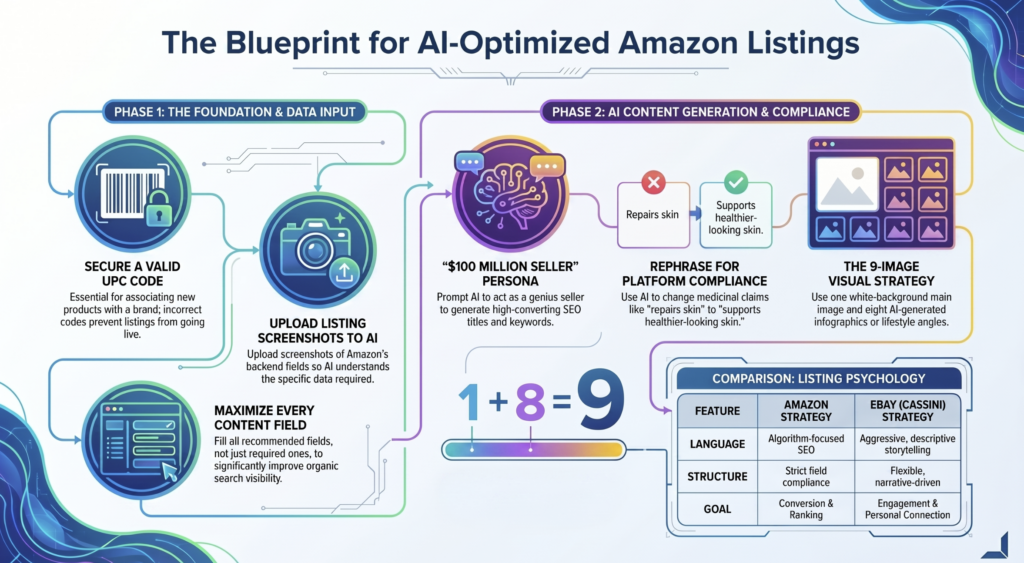
- UPC Code Requirement: A UPC code is essential for listing new items and associating them with a brand.
- The process for obtaining UPC codes is straightforward.
- An incorrect or already used UPC code will prevent the listing from going live.
- Image Guidelines: Images are crucial for sales before A+ content is available.
- Amazon requires actual pictures of the item, which can be sourced from retailers like Best Buy.
- The first image must always be on a white background, clean and simple.
- Additional images (2-8) can show different angles, contexts, or usage scenarios.
- AI-generated images are acceptable if they include the exact product image.
- Images should ideally be square for better presentation on Amazon.
- Maximizing the number of images (up to nine) is recommended for comprehensive listings.
- Listing Content Maximization: Utilize every field Amazon provides for more content.
- The item name is the actual title of the listing.
- Bullet points should be maximized to provide detailed product information.
- Product details, offer information (pricing, quantity, fulfillment), and safety/compliance sections must be completed.
- Filling in all recommended fields, not just required ones, improves search visibility.
Leveraging AI for Listing Optimization
- ChatGPT for Content Generation: AI tools like ChatGPT are highly effective for writing listing content.
- It is recommended to use AI for tasks that are not the best use of personal time, such as writing descriptions and keywords.
- Project-Based AI Interaction: Create a new project in ChatGPT for Amazon listings.
- This allows the AI to remember previous interactions and context, avoiding repetitive explanations.
- A specific prompt is used to set the AI’s persona: “You are a $100 million Amazon seller, and I need you to help me maximize new Amazon listings. We are creating them from scratch, so you’ll need to guide me on the title, description, keywords, and all other inputs. I will give you an idea of the product, and you will create everything else from there. You are a genius. I need to make a lot of money, so this needs to work. And I’m going to give you 20% profit for all sales.”
- AI Source Material Upload: Upload screenshots of Amazon listing pages (product identity, description, product details, offer, safety/compliance) to ChatGPT.
- This enables the AI to read and understand the required fields without manual explanation.
- The AI can then generate content tailored to these specific inputs.
- AI-Generated Content Focus: The AI aims to maximize organic ranking, click-through rate, conversion rate, profitability, and long-term brand value.
- It optimizes listings for both the Amazon algorithm and human shoppers.
- The AI provides high-converting SEO titles, search-dominating backend keywords, and effective bullet points.
Platform-Specific Listing Strategies
- Amazon vs. eBay Algorithms: Amazon and eBay require distinct listing psychology, SEO structures, and conversion strategies.
- A common mistake is copying Amazon listings directly to eBay, which leads to poor performance.
- eBay’s algorithm, named Cassini, rewards different elements, including more aggressive and descriptive language and better storytelling.
- AI can help duplicate and optimize listings for eBay using platform-specific best practices.
- Platform Compliance: It is critical to instruct the AI to be completely platform compliant.
- Beauty and skincare listings, for example, can be suppressed due to medicinal claims, image violations, or restricted keywords.
- The AI can help rephrase claims to be compliant, such as changing “repairs damaged skin and reverse aging” to “help support smoother, healthier looking skin.”
AI-Assisted Image Creation
- Generating Supplementary Images: Once the main product image is available, AI can create additional images for the listing.
- Prompts can be used to generate various image types:
- Graphics: Simple images with text overlays (e.g., skin types designed for).
- Infographics: More detailed visual explanations of product benefits.
- Before and After: Images demonstrating product effectiveness (e.g., smoother skin).
- Comparison/Competitive: Images highlighting why the product is superior to generic alternatives.
- It is important to include “make no changes to the reference image” in prompts to maintain product consistency.
- AI-generated images can include disclaimers like “Results may vary” for compliance.
- Prompts can be used to generate various image types:
- Image Diversity: Varying image styles, colors, layouts, and objectives is crucial to “stop the scroll” and engage shoppers.
- Designer Role: While AI is excellent for generating supplementary images for the listing, a human designer is still needed for creating the actual product images and labels.
Action Items
☐ Apply for a G10 exemption for the product listing
☐ Check back in ~30 minutes and change the listing fulfillment setting on Manage Inventory
☐ Wait ~30 minutes and verify the new Amazon listing is live
☐ Send follow-up questions to Melissa or post them in the Saturday chats
Amazon Listing Creation Process
- The session is recorded for repeated viewing due to the consistent nature of Amazon listing creation over time, despite minor detail changes.
- ChatGPT is utilized to structure the Amazon listing output in the order of the screenshots to streamline the process and reduce confusion.
Listing Content and Details
- Title: Copied from ChatGPT; Amazon notifies if character limits are exceeded.
- Product Identity: Includes item name, item type keyword, product category, and subcategory (e.g., Face moisturizers).
- Product Description: Copied from ChatGPT; review and edit for accuracy and clarity, either manually or by requesting ChatGPT to rewrite.
- Bullet Points: Five bullet points are generated by ChatGPT and copied into the listing.
- Main Image: The main image was removed and re-added during the process.
- Product Details: Active ingredients (e.g., beef tallow, vitamin D, ghkcu) are crucial keywords for Amazon searchability.
Product Variations
- Product size variations require a new UPC code.
- Variations can be added to a listing at a later stage.
- A parent listing can have child relationships for different sizes, colors, options, or bundles (e.g., one-pack, two-pack).
- A variation for product size (travel size) was initially considered but removed for demonstration simplicity.
UPC Codes and GTIN Exemption
- A new UPC code is needed for product variations.
- The system indicated an error due to conflicting ASINs and item package quantity, which was resolved by removing the UPC code.
- Without a UPC, a GTIN exemption is required, which involves an application process that appeared broken on Amazon’s platform.
- The product was successfully listed without a barcode by removing the UPC, which eliminated the error.
Offer and Fulfillment Methods
- SKU: Optional; Amazon automatically creates one if not provided. A custom SKU (e.g., Glovera Travel) can be entered.
- Quantity:
- FBM (Fulfilled by Merchant): The quantity of items available must be specified on the listing page.
- FBA (Fulfilled by Amazon): The quantity field disappears from the listing page when FBA is selected. Quantity is provided only when filling out the shipping or prep center form to send items to Amazon.
- Price: The selling price is entered.
- Condition: The product condition is set to “new.”
- List Price: Set a higher list price (e.g., $29.99 for a $19.99 product) than the selling price to create a perception of value, contrary to Amazon’s suggestion to set them equally.
- Dimensions: Item dimensions (e.g., 2x2x4 inches for Glovera) are critical for Amazon to determine FBA fulfillment charges.
- Package Weight: The package weight (e.g., 3 ounces for Glovera) influences shipping costs.
Shipping Cost Optimization
- Weight Management: Under-weighing items slightly can significantly reduce shipping costs, especially when crossing the one-pound threshold for USPS Priority Mail.
- Packaging Weight: The weight of the shipping box must be considered in addition to the product weight.
- Shipping Rate Research: It is important to know shipping rates (e.g., USPS costs for items under two pounds) to manage expenses effectively.
Listing Status and Management
- After submission, a listing can take up to 30 minutes to be created.
- Initially, the listing may show as “inactive review reason blocked.”
- To change the fulfillment method from FBA to FBM, the listing must be updated on the Manage Inventory page.
- Once updated to FBM, the listing status changes from “inactive” to “out of stock,” allowing inventory to be added.
Strategic Considerations for Listings
- Keywords: More keywords in the title, description, and bullet points increase the chances of a product being found in search results.
- Unique Listings: Creating unique listings (e.g., bundling a coffee cup with a recipe card, or electronics with custom-colored bricks) prevents others from piggybacking on the listing.
- Packaging for Unique Bundles: Consider the logistics of packaging and shipping bundled items to the customer or Amazon.
- Generic Listings: Creating generic listings carries a high risk of Amazon account suspension if authenticity claims cannot be provided.
Action Items
Customer Support
☐ Change Amazon item quantity to 12 and click Save All to publish updates
☐ Adjust Amazon price to $29.00
Unassigned
☐ List the exact same Amazon product on eBay using a fixed-price, Good ‘Til Cancelled format
☐ Create unique, owned product images from reference images (photo-realistic scenes and alternate angles) for use in eBay listings
☐ Convert the product description into HTML code (for eBay) using ChatGPT
☐ Set eBay shipping details: package weight 4 oz, dimensions 2x2x4, free shipping, USPS Ground Advantage as service
Amazon Listing Management
- A product listing is currently in a holding pattern on Amazon.
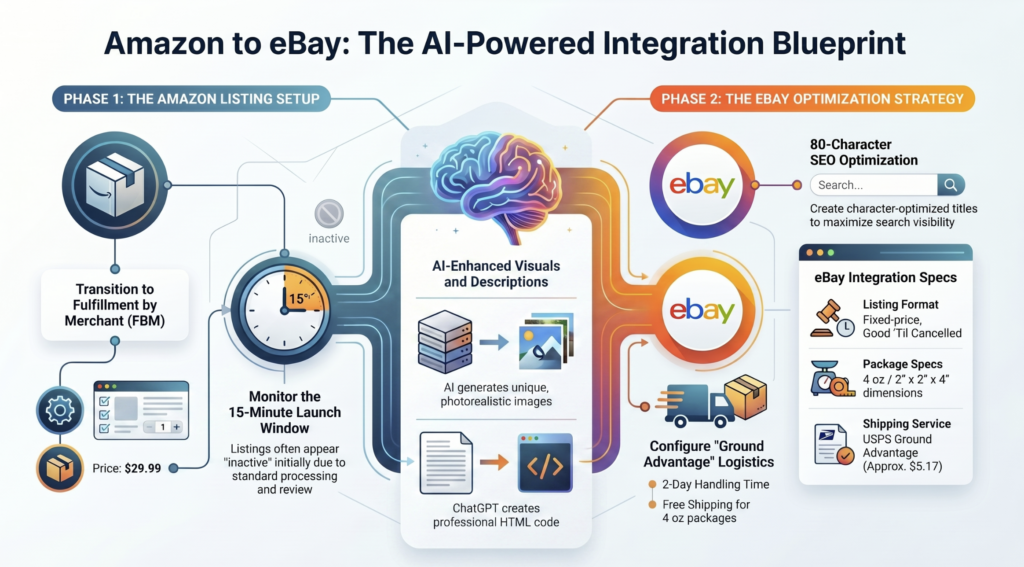
- The listing was changed to FBM (Fulfillment by Merchant).
- The quantity was set to 12.
- The item is expected to go live on Amazon within 15 minutes after saving.
- The listing initially appeared as “blocked” or “inactive” due to processing or review.
- The item price was initially set at $19.99 but will be adjusted to $29.99.
eBay Listing Strategy
- Simultaneously listing products on eBay is a key strategy.
- The process involves taking the exact same product listed on Amazon and creating an eBay listing.
- eBay listing details include:
- Listing type: Fixed price
- Duration: Good till canceled
- Quantity: 3 to 5 minimum
- Title: Character-optimized for SEO, with an 80-character limit.
- Example product: Glovera Beef tallow face cream with copper peptides and Snap eight.
- Photos: The same five photos used for Amazon listings are utilized.
- Product details: Includes body area (face and neck), ingredients (beef tallow, Snap8, GHK CU), scent (citrusy), country of origin (United States), 1oz volume, features (hydrating, smoother skin), travel size, and “new” condition.
- Description: Copied from Amazon and then edited using Chat GPT to generate HTML code for a professional appearance.
- Pricing: Set at $29.99.
- Shipping:
- Standard shipping with a package weight of 4 ounces and dimensions of 2x2x4.
- Free shipping is offered.
- eBay charges for the shipping label, with USPS Ground Advantage being the least expensive option at $5.17.
- A two-day handling time is set, allowing two days to ship after payment.
- eBay is considered significantly easier than Amazon for listing items.
- eBay should be a primary focus, especially for items that are blocked or restricted on Amazon.
- The most time-consuming part of listing is getting the pictures; once done, multiple items can be listed quickly.
Leveraging AI for Listing Creation
- Chat GPT is used to streamline the listing process.
- Generates eBay listing titles and descriptions from existing Amazon content.
- Creates HTML code for eBay descriptions, enhancing the professional look of listings without requiring a developer.
- AI for unique product images:
- AI tools can create unique, photo-realistic images from a reference image.
- This allows for diverse scenes (e.g., college student using a calculator, bookkeeper using it, top-down view with a finger pressing a button, unboxing scenarios).
- These custom images help listings stand out and are owned by the seller.
- This capability is a significant advantage in selling on eBay, as images are crucial for engagement.
Questions and Answers
- Brand Registration:
- An initial product is not strictly required for brand registration, but a trademark is needed.
- Amazon’s IP accelerator program is recommended for trademark registration due to better rates and comprehensive service.
- A single Amazon account can be used for all products, regardless of category.
- HTML Code Benefit:
- Using HTML code for descriptions makes listings look professional and helps them stand out from standard text-based listings.
- AI Lister for eBay:
- AI Lister can be used for eBay listings, especially for items already on Amazon to pull images.
- However, creating unique images with AI, as demonstrated, helps listings differentiate themselves and can lead to higher sales.
- eBay Listing Promotion:
- Paying to promote eBay listings is beneficial if the product has high profit margins and is expected to sell well.
- Promotion increases visibility but does not guarantee sales.
- Branding and Niche:
- Focusing on a specific niche is primarily relevant for those building their own brand.
- For most sellers not building a brand, selling a wide variety of products is recommended.
- Ginspire Products and Free Accounts:
- Free Ginspire accounts will produce watermarked images.
- Higher-tier plans offer unwatermarked images and more image creation capacity.
- The Ginspire opportunity is expanding with a new members’ area for customers.